Asphalt Shingles vs. Metal Roofing: A Lifetime Cost Comparison
When homeowners compare asphalt shingles and metal roofing, the first question is usually: Which one costs less?
If you’re only comparing the initial installation price, asphalt shingles usually win. But if you’re planning to own your home for decades, the better question is:
Which roofing system offers the better value over its entire lifespan?
The answer depends on how long you plan to own the home, the type of metal roofing you’re considering, your local climate, and the quality of the installation.
Asphalt Roofing: Lower Cost Up Front
Asphalt shingles remain one of the most common residential roofing materials because they’re relatively affordable, attractive, and available in a wide range of styles.
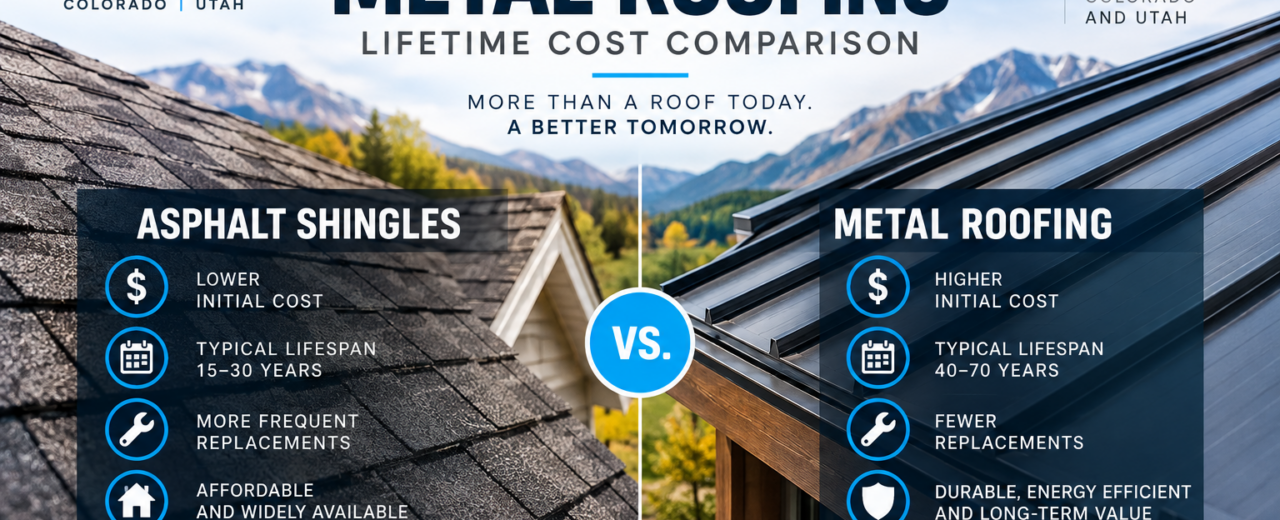
National estimates vary significantly by home and roofing product, but asphalt roofing generally costs considerably less to install than metal. Current estimates also put typical asphalt-roof service life around 15–30 years, although premium products and favorable conditions can extend that. (This Old House)
That lower initial investment makes asphalt attractive to homeowners who don’t expect to stay in the home for several decades.
The tradeoff is replacement frequency.
If you own a home for 50 or 60 years, you could potentially replace an asphalt roof two or even three times.
Metal Roofing: Higher Initial Investment, Longer Potential Life
Metal roofing changes the equation.
Depending on the metal and roofing system, a properly installed metal roof may last approximately 40–70 years. (This Old House)
That longevity comes at a price. Metal roofing can cost substantially more upfront than asphalt shingles, particularly with premium systems such as architectural standing-seam metal. (This Old House)
But a homeowner who installs one quality metal roof may avoid one or more future roof replacements.
That’s where lifetime roofing cost becomes important.
A Simple Lifetime Cost Example
Consider a hypothetical homeowner choosing between:
Asphalt roof: $20,000 with a 25-year service life
Metal roof: $40,000 with a 50-year service life
At first, asphalt looks like the obvious choice.
But over 50 years, the homeowner may need two asphalt roofs:
$20,000 + another future replacement = $40,000+
And that’s before considering inflation. A roof that costs $20,000 today almost certainly won’t cost $20,000 several decades from now.
Meanwhile, if the metal roof reaches its expected service life, the homeowner may still be on the original roof.
This is only an illustration—not a guarantee of actual roof life or future costs—but it demonstrates why comparing bids solely by today’s price can be misleading.
What About Maintenance and Repairs?
Both roofing systems require proper installation and periodic inspections.
Asphalt shingles can experience granule loss, cracking, wind damage, and deterioration as they age. Metal roofing eliminates many of those concerns but introduces others, including potential coating deterioration, fastener issues on exposed-fastener systems, sealant maintenance, and possible hail denting.
Neither roofing system should be considered maintenance-free.
Which Roof Is the Better Investment?
There’s no universal winner.
Asphalt shingles may make more financial sense when keeping the initial investment low is the priority, you’re unlikely to own the home long enough to realize metal’s longevity advantage, or the home’s design doesn’t justify the additional investment.
Metal roofing becomes more compelling when you expect to own the property long-term and value durability, reduced replacement frequency, and a potentially much longer service life.
For homeowners in Colorado and Utah, durability also deserves extra consideration because roofing systems can face hail, snow, high winds, UV exposure, and significant temperature swings.
At The Roofing Center, we believe homeowners should compare more than the price on today’s estimate. The better question is:
What will this roof potentially cost me over the entire time I own my home?
Sometimes the least expensive roof today isn’t the least expensive roof over the long run.